Grades of piles: how to read yours
From the UK NICE guideline's description:
- Grade 1: inside the passage. "Symptoms of bleeding, itching or discomfort." Some people have no symptoms.
- Grade 2: come out when you pass stool and "may reduce spontaneously", that is, go back in on their own.
- Grade 3: come out and "may need to be reduced digitally", that is, pushed back with a finger.
- Grade 4: "may not be reducible, remaining continually prolapsed", that is, stay outside all the time.
In plain words: 1 is inside, 2 comes and goes, 3 needs a push, 4 stays out. You can often tell your own grade from that. A doctor confirms it with a quick examination, which is also how they rule out the other causes of bleeding.
Piles treatment without surgery: grades 1 and 2
The NICE guideline's first line for grades 1 and 2: "dietary modification or use of laxatives", and "corticosteroid creams or local anaesthetics" for symptoms. The UK health service's self-care: fluid and fibre to keep stool soft, a warm bath, an ice pack in a towel, paracetamol, keep the area clean and dry, do not push, do not spend long on the toilet, do not ignore the urge. A chemist can give creams for pain and itching, and laxatives to soften stool.
This is where most piles are treated, and most stay. The whole first half of this series is this step: the piles diet chart, the stool rules in constipation and piles, and the home remedies for piles. The UK rule for moving on: no improvement after 7 days of home treatment, or piles that keep coming back, means a doctor.
Piles treatment in a clinic: banding, injection, infrared
If home care is not enough for grade 1 or 2, there are small procedures done in a clinic, usually without a general anaesthetic. From the UK health service's page:
- Rubber band ligation (banding): "a band is placed around your piles to make them drop off."
- Sclerotherapy (injection): "a liquid is injected into your piles to make them shrink."
- Electrotherapy: "a gentle electric current is applied to your piles to make them shrink."
- Infrared coagulation: "an infrared light is used to cut the blood supply to your piles to make them shrink."
Banding for piles, step by step
From a UK hospital patient leaflet: "Using a short telescope, tiny rubber bands are placed inside the back passage above the piles." "This tightens and cuts off the blood supply to the piles." "After 7 to 10 days the tissue in the band will fall away." The feeling after "will fade to a mild discomfort or ache lasting a couple of days." The leaflet's warning: "Very rarely you may get large amounts of bright red bleeding after 7 to 10 days", which needs urgent care. And its honest line: banding "is a simple and effective treatment for piles but sometimes you may still have remaining symptoms", so it may be repeated.
Banding is a clinic procedure, not an operation: no cutting, and in most cases no general anaesthetic. Ask your doctor what to expect on the day and in the week after.
Piles surgery: grades 3 and 4
The hospital leaflet: "Grade 3 and 4 haemorrhoids, which hang outside your back passage, may require surgery." The NICE guideline lists for these grades: haemorrhoidectomy, stapled haemorrhoidopexy, haemorrhoidal artery ligation, and bipolar electrocoagulation. The UK health service explains the three operations in one line each:
- Haemorrhoidectomy: "your piles are cut out."
- Stapled haemorrhoidopexy: "your piles are stapled back inside your anus."
- Haemorrhoidal artery ligation: "stitches are used to cut the blood supply to your piles to make them shrink."
Which one you get is the surgeon's call, based on your grade, your symptoms and your health. The questions worth asking: which operation, why that one for me, how long off work, and what the plan is if they come back.
Do not wait for grade 4. A grade 3 pile that is pushed back every day is already a surgical question. Waiting until it stays out does not make the operation smaller. And a fistula, which gives pus and a throbbing pain, is not piles at all and rarely heals without surgery; our piles symptoms blog tells them apart.
Piles operation recovery: what to expect
From the same hospital leaflet, for the operation that cuts the piles out: "You are likely to experience some pain following this procedure when the local anaesthetic wears off." "This will get better but may take up to 6 weeks to resolve completely." Return to work is usually around 2 weeks, depending on the job; "You can drive 2 weeks after the operation." On recurrence: "If this happens, you may need further treatment or another operation."
So: a painful first week or two, a slow settle over six weeks, and a plan for life afterwards. The leaflet's after-care list is the same list as this whole series: at least 6 to 8 glasses of fluid a day, a high-fibre diet and softening laxatives, no straining, keep toilet sessions to around 5 minutes, and "keep active, this doesn't have to be with exercise, but short walks can encourage gut motility."
What the old books did
Charaka's chapter on piles (Chikitsa Sthana 14) describes four ways of treating them: medicines and diet, a caustic alkali application (kshara), heat application (agnikarma), and surgery (shastra). It also warns of the complications of these procedures done badly: bleeding, the passage slipping out, narrowing. So the old books knew both that piles sometimes need a procedure and that procedures carry risk. For most piles, the chapter's answer is the one this series keeps giving: remove the causes, keep digestion strong, soft food, buttermilk.
The Ashtanga Hridaya's line, that piles uprooted with takra do not grow back, is in the same spirit: the habit, not the knife, is what stops the return.
One honest note. A thread treatment descended from the old kshara method (ksharasutra) is used in Ayurvedic hospitals today for piles and fistula. We did not check its trial evidence for this blog, so we do not make claims for or against it here. Ask an Ayurvedic surgeon about it the way you would ask any surgeon: what, why me, how long, what if it returns.
After any treatment: why piles come back
The UK health service's treatment page ends with a sentence most people skip: "Treatment does not always prevent piles coming back." Banding, injection, even surgery remove the pile that exists. They do not change the hard stool, the pushing, the phone on the toilet, or the nine-hour chair that made it. Charaka's root cause, constipation from weak digestion, is still there the day after the operation.
The after-treatment plan, in one line each: 1.5 to 2 litres of fluid; atta not maida, a katori of dal at both meals, a sabzi, fruit with skin; isabgol in a full glass at night if needed; chaas with lunch; go when the urge comes, footstool, no pushing, 5 minutes, no phone; stand every 30 minutes; a walk after meals. Our piles mistakes blog is the checklist.
Piles treatment: grade 1 and 2, fix the stool and the habits; grade 3 and 4, see a surgeon. After any of it, keep the habits, or the piles return.
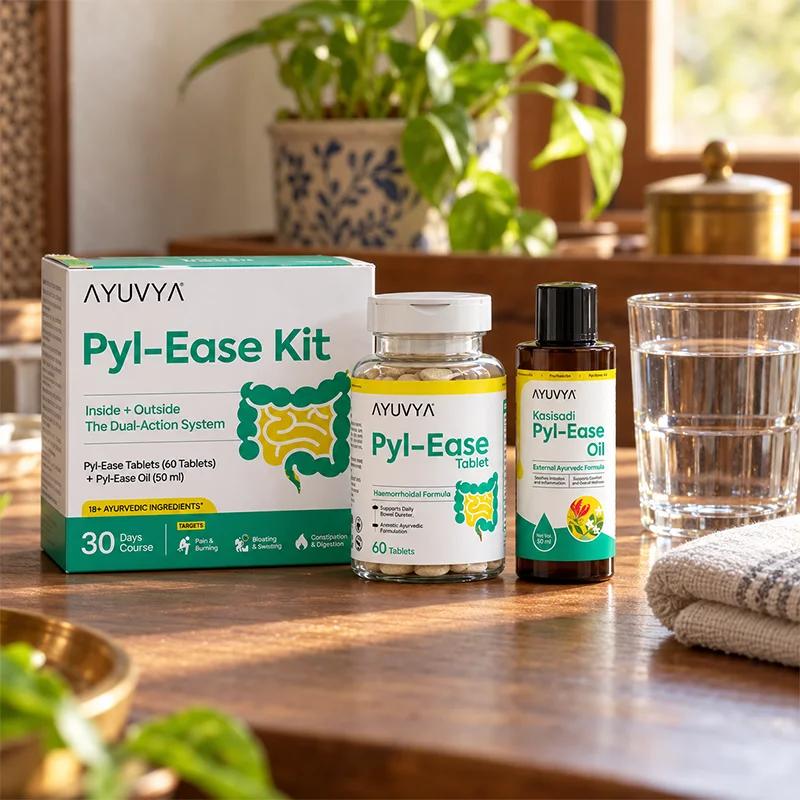
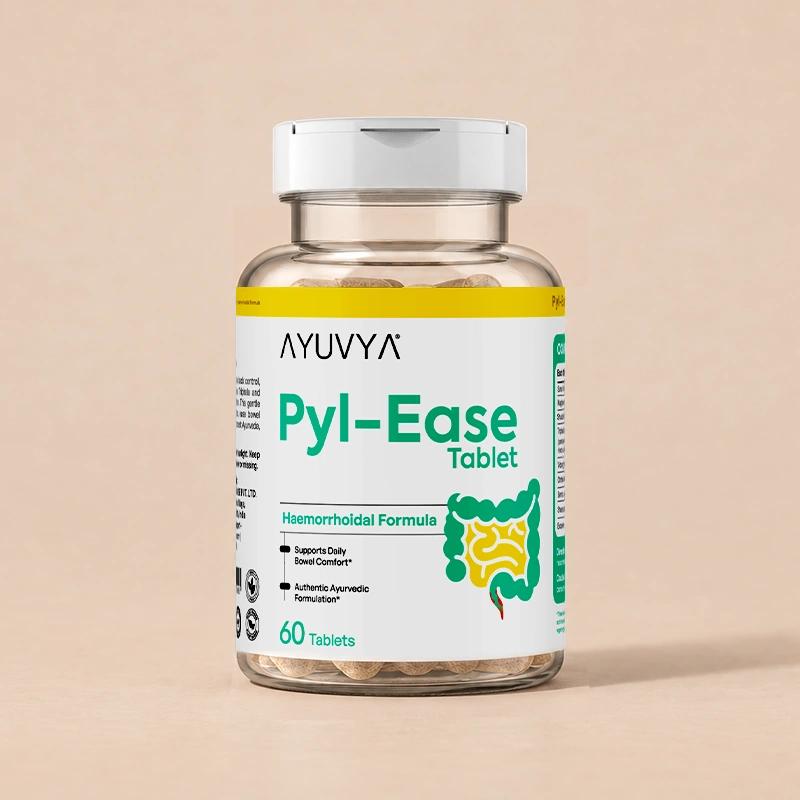
Ayuvya's Pyl Ease is made from Ayurvedic herbs to support people with piles, and comes with a piles diet chart that is the after-treatment plan above. See Pyl Ease. It works alongside your doctor's plan, not instead of it.
Sources
- NHS (UK). Piles (haemorrhoids): treatment: self-care, pharmacist options, hospital treatments without surgery (banding, sclerotherapy, electrotherapy, infrared coagulation), surgery (haemorrhoidectomy, stapled haemorrhoidopexy, haemorrhoidal artery ligation), and "treatment does not always prevent piles coming back". nhs.uk
- NICE (UK). Guidance HTG377, chapter 2: indications and current treatments (grade definitions; treatments for grades 1–2 and 3–4). nice.org.uk
- University Hospitals Plymouth NHS Trust. Patient information leaflet: Haemorrhoids (grading; banding procedure and after-effects; surgery for grades 3 and 4; recovery; recurrence; after-care). plymouthhospitals.nhs.uk
- NHS 111 Wales. Haemorrhoids (piles): when to see a GP. 111.wales.nhs.uk
- Charaka Samhita, Chikitsa Sthana, chapter 14 (Arsha Chikitsa): the four approaches to treatment and the complications of improper procedures; constipation as the root cause. carakasamhitaonline.com
- Ashtanga Hridaya, Chikitsa Sthana, chapter 8, verse 42 (takra). English rendering at Easy Ayurveda. easyayurveda.com