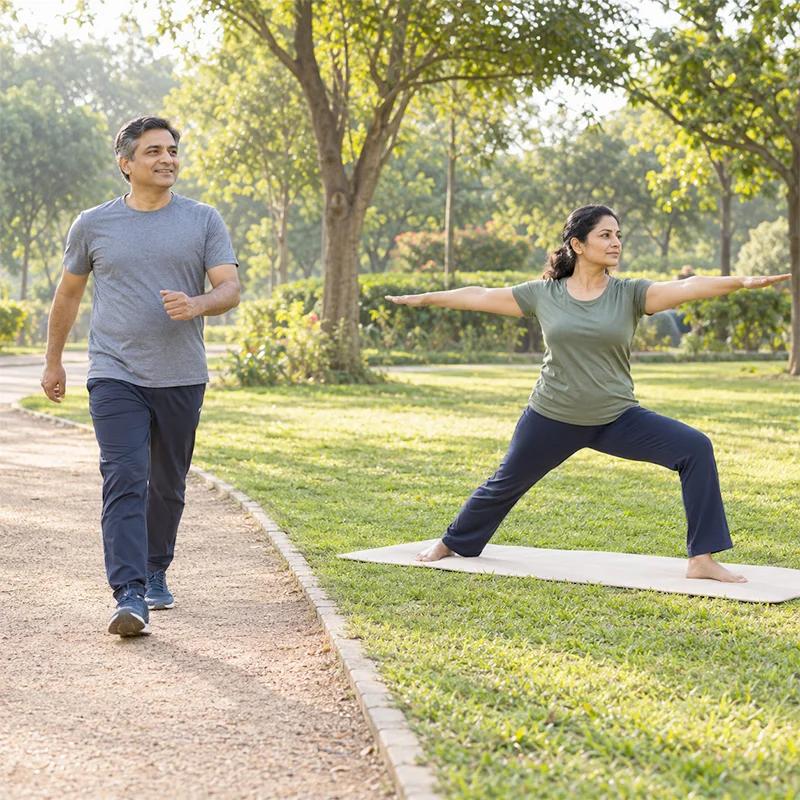

The quick answer, in one table
What the study reviews found, compared with doing nothing
Walking (21 studies) | Yoga (37 trials) | |
|---|---|---|
Bad cholesterol (LDL) | down about 7 mg/dL | down about 12 mg/dL |
Total cholesterol | down about 7 mg/dL | down about 18 mg/dL |
Good cholesterol (HDL) | no clear change | up about 3 mg/dL |
Triglycerides | no clear change | not reported in the summary |
Blood sugar after meals | down 12% with 10 min after each meal | no clear change in the review |
Blood pressure | not in the review | top number down about 5 |
Easy to keep for years? | Yes. No mat, no teacher, no cost | Needs a routine, and ideally a teacher at first |
Keep one thing in mind while reading: a 7 or 12 mg/dL drop is real but small. If your bad cholesterol is 160, exercise alone will not bring it to 100. Exercise is one of the five or six habits, not the whole plan.
Does walking lower cholesterol? The honest numbers
Walking has a huge name. The numbers are more modest than the name.
21 studies, 1,129 people (review published 2022). Women who were overweight walked at a moderate pace for 4 weeks or more. Compared with not walking: total cholesterol down about 7 mg/dL, bad cholesterol down about 7 mg/dL. Good cholesterol and triglycerides did not change clearly. The doctors who summarised it said the change "may have little clinical impact".
A separate review of exercise and good cholesterol. Good cholesterol rose by about 2.5 mg/dL once people did at least 120 minutes a week. Below that, little happened.
So why does every doctor still say "walk"? Because walking does things the lipid report does not show:
- It lowers blood sugar after meals. In a trial of 41 people with diabetes, 10 minutes of walking after each meal cut the sugar rise by 12%, and by 22% after dinner. Even 2 to 5 minutes of light walking after a meal helped in another review.
- It is the habit people keep. No mat, no class, no money. Every trial above worked only because people kept going. Walking is the easiest habit to keep for 20 years.
- The old books put it first. Charaka's diet for people with too much body fat ends with exercise and staying awake, not sleeping in the day.
Yoga for cholesterol: what 37 trials found
In the trials, yoga did as well as gym-style exercise on heart risk numbers.
37 trials, 2,768 people (review published 2014, European Journal of Preventive Cardiology). Compared with no exercise, yoga lowered bad cholesterol by 12.14 mg/dL, raised good cholesterol by 3.20 mg/dL, lowered total cholesterol by 18.48 mg/dL, and lowered the top blood pressure number by about 5. Body weight dropped about 2.3 kg. Blood sugar numbers did not improve.
The surprise: when yoga was compared with running, cycling and similar exercise, the results were about the same. The lead researcher called yoga "potentially very useful and in my view worth pursuing".
Why would slow yoga match fast exercise? The researchers' guess: yoga gives some of the same body work, plus a calming effect on stress. Stress is a quiet driver of heart risk. Yoga works on both at once.
An honest note. The yoga trials were mostly short, with small groups, and the yoga styles were different from trial to trial. So the exact numbers may shift as better trials come. The direction, though, is clear: yoga is not "just stretching". It counts.
Walking vs yoga for cholesterol: the verdict
If you can only do one thing:
- Your sugar is also high? Walk after meals. That is the one thing yoga did not do in the review.
- Your blood pressure and stress are high? Yoga. It moved pressure and weight along with cholesterol.
- You have stopped and started exercise ten times before? Walk. It is the habit that survives.
If you can do two things: walk after meals every day, and yoga 3 mornings a week. That is what the plan below does.
The Ayurveda exercise rule: half your strength
What exercise does (Charaka, Sutra Sthana, chapter 7). Exercise brings lightness of the body, ability to work, firmness, strength to bear difficulty, less body fat, and a good appetite.
How much: half your strength. The old books say exercise to half of your capacity, and stop before you are tired. The signs that you have reached "half": sweat at the armpits, the temples and the nose, and a dry mouth. When you see these, stop. This rule is in Sushruta (Chikitsa Sthana 24) and in Vagbhata (Ashtanga Hridaya, Sutra Sthana 2).
Who should not exercise (Charaka 7/35): a person who is hungry or thirsty, very old, very weak, angry, sad or frightened, or already tired from walking or carrying loads. Pregnant women are told to avoid it too (Charaka 25/40).
Seasons: winter and spring are the seasons for exercise. In peak summer and the rainy season, the old books say go easy.
Read that half-strength rule again. Most people over 40 who start exercising do too much in week one, hurt a knee, and stop. The old books are telling you the same thing a good trainer would: stop at the first real sweat, and come back tomorrow.
How much to walk daily for cholesterol
The target: 150 minutes a week. That is the number in the American Diabetes Association's activity advice, with no more than 2 days off in a row. It is 30 minutes on 5 days. Or, easier: 10 minutes after each meal, every day. That is 30 minutes without ever "going for a walk".
The first milestone: 120 minutes a week. That is where good cholesterol started to rise in the exercise review.
Sitting rule: the same diabetes advice says to get up for 3 minutes of light movement every 30 minutes of sitting.
Pace: fast enough that you breathe a little harder but can still talk. If you cannot talk, you have passed the half-strength line.
A weekly plan that fits an Indian day
When | What | Minutes |
|---|---|---|
Mon, Wed, Fri morning | Yoga at home or a park group: simple asanas, slow breathing, 5 minutes of rest at the end | 30 |
Every day, after breakfast | Walk, inside the house or on the terrace is fine | 10 |
Every day, after lunch | Walk, slow, around the office or the colony | 10 |
Every day, after dinner | Walk, this is the one that matters most for sugar | 10 to 15 |
Sunday | One longer walk with family, or rest if the body asks | 30 to 45 |
Total: about 90 minutes of yoga and 210 to 250 minutes of walking a week. Well past both the 120 and 150 minute lines, and nothing in it needs a gym.
One old rule for the after-dinner walk: the old books say sit for a while after eating, then walk a little. Sushruta's words: "sit like a king" after the meal, then walk. So finish eating, sit 10 minutes, then walk. Do not jump up from the plate.
4 mistakes that waste the effort
- One big walk on Sunday, nothing all week. The reviews needed regular weeks. The diabetes advice says no more than 2 days off.
- Going full strength in week one. Charaka's half-strength rule exists because of this. Sore knees end more exercise plans than laziness does.
- Walking, then a "reward" of samosa or sweets. A 10-minute walk burns far less than one samosa gives. Reward yourself with the walk itself.
- Expecting the report to fall by 40 points. Exercise gives 7 to 12. Diet gives the rest. Medicine, if your doctor gave it, stays.
Walking vs yoga for cholesterol is the wrong fight. Walk after meals, do yoga 3 days, fix the plate.
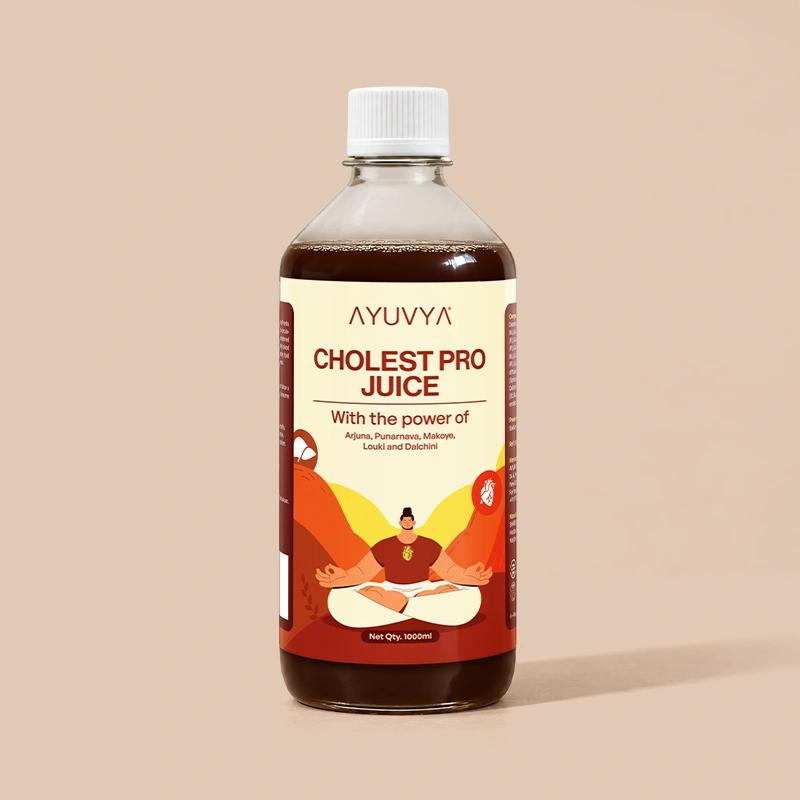
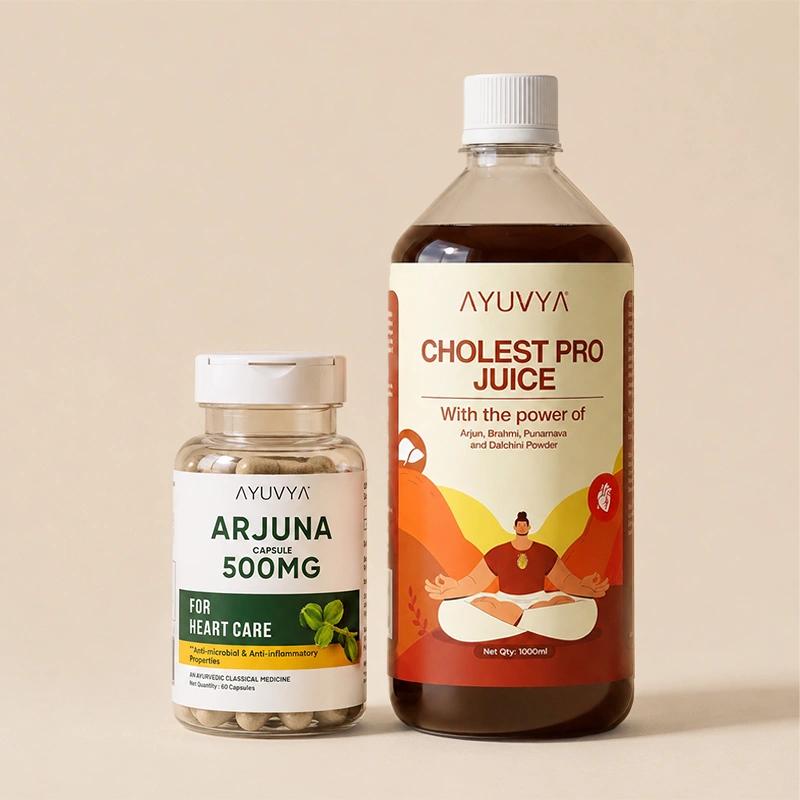
Ayuvya's Care of Cholesterol juice is built from Ayurvedic herbs for daily support, and comes with a simple Indian diet chart so the plate matches the walk. See Care of Cholesterol, or read our full guide to walking after meals.
Related reading: Habits that raise cholesterol · Walking after meals for blood sugar · High cholesterol symptoms
This article is for general information. It is not medical advice. If you have heart disease, joint problems, or are over 60 and have not exercised for years, ask your doctor before starting. Exercise does not replace medicine your doctor has prescribed.
Sources
- Evidence summary, "Does regular walking improve lipid levels in adults?", Journal of Family Practice (via MDedge), covering a 2022 meta-analysis of 21 studies (n=1,129) and three trials. mdedge.com
- European Society of Cardiology press release, December 2014, on Chu P and colleagues, European Journal of Preventive Cardiology: yoga and cardiovascular risk factors, 37 trials, 2,768 people. escardio.org
- Kodama S and colleagues. Effect of aerobic exercise training on serum levels of high-density lipoprotein cholesterol: a meta-analysis. Archives of Internal Medicine, 2007 (HDL +2.53 mg/dL; 120 minutes a week threshold), as reported by ScienceDaily. sciencedaily.com
- Reynolds AN and colleagues. Advice to walk after meals is more effective for lowering postprandial glycaemia in type 2 diabetes. Diabetologia, 2016 (41 people; 12% overall, 22% after dinner), as reported by the University of Otago. otago.ac.nz
- Buffey AJ and colleagues. The acute effects of interrupting prolonged sitting with light walking or standing. Sports Medicine, 2022 (7 studies; 2 to 5 minutes of walking helped), as reported by KSL. ksl.com
- American Diabetes Association. Physical activity/exercise and diabetes: a position statement. Diabetes Care, 2016 (150 min/week; no more than 2 days off; 3 minutes of light activity every 30 minutes). diabetes.acponline.org
- Sushruta Samhita, on sitting comfortably after meals and then taking a short walk (as quoted in the Journal of Ethnic Foods, 2019). link.springer.com
- Charaka Samhita Online, "Vyayama" (exercise): Charaka Sutra Sthana 7/32–35, 8/18, 21/28, 25/40; Sushruta Chikitsa Sthana 24/46–47; Ashtanga Hridaya Sutra Sthana 2/11, 3/11, 3/26–27. carakasamhitaonline.com