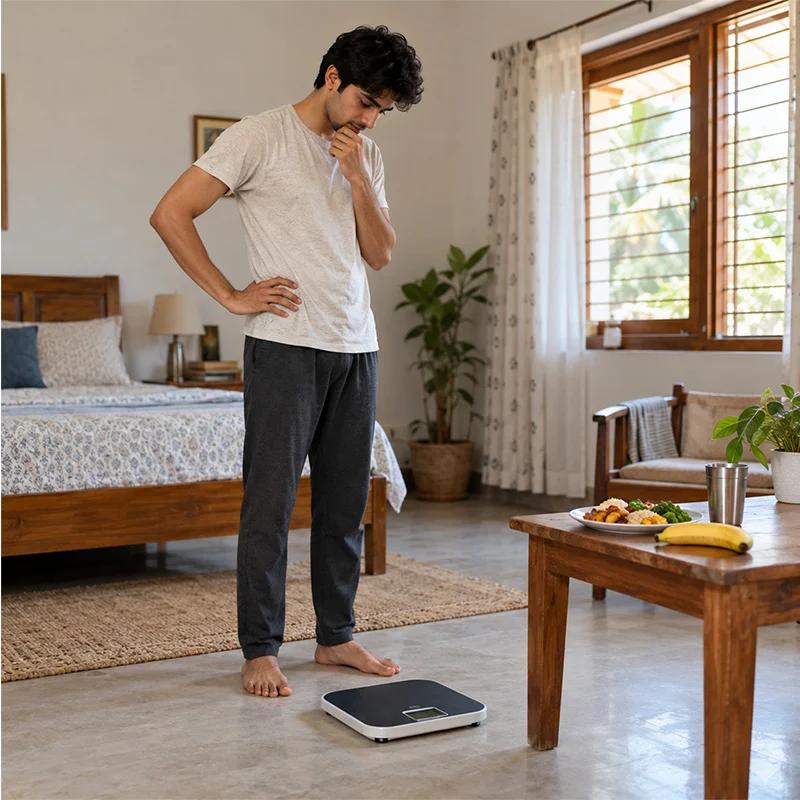



First: are you actually underweight?
Many people who want to gain weight are a normal weight. They just want to look bigger. That is a different goal, and a gym goal more than a food goal. So check first.
The WHO weight ranges (BMI): below 18.5 is underweight. 18.5 to 24.9 is normal. Indian guidelines call 23 to 24.9 overweight for Indians and 25 and above obese, because Indians carry fat differently. BMI is your weight in kg divided by your height in metres, twice. A person 1.70 m tall and 52 kg has a BMI of 18. That is underweight. The same person at 58 kg is 20, normal.
If your BMI is 18.5 or more and steady, you are not underweight. You may still want more muscle, and the food advice below helps, but there is nothing wrong with your body. If your BMI is under 18.5, or your weight is going down without trying, read on carefully.
What Charaka said about the thin body
Everyone knows Ayurveda talks about the fat body. Fewer know that the same chapter talks about the thin one, in the same breath. Charaka's chapter 21 of the Sutra Sthana is called "the eight despised ones", and the too-thin person is on the list next to the too-fat one.
What makes a person thin (21/11–12): eating dry, non-oily food and drinking dry things; fasting; eating too little; too much purging; grief; holding back natural urges; too little sleep; dry rubbing of the body; too much bathing; heredity; old age; long illness; and anger.
What the thin person suffers (21/13–15): cannot tolerate exercise, large meals, hunger, thirst, cold, heat or disease; is prone to spleen disease, cough, wasting, breathlessness, abdominal lumps and piles; has "dried up buttocks, abdomen and neck".
And then the surprise (21/17): "Of the two, lean is less harmful than obese." The fat person suffers more, in body and mind. So being thin is a problem to fix, not a disaster to panic about.
The treatment (21/20, 21/29–34): for the too-thin person, "light and nourishing therapy". Milk, ghee, dahi, rice, urad (masha), wheat, sugarcane, jaggery preparations, and newly harvested grains. Plus: sleep, a comfortable bed, contentment, a relaxed mind, freedom from anxiety, oil massage, and pleasant surroundings.
Read the causes list once more. Dry food. Too little sleep. Grief. Anger. Eating too little. Two thousand years later, that is still most of the answer. Now the 9 reasons, in the order we see them.
Why am I not gaining weight? The 9 reasons
Write down one day's food. It is often smaller than it feels.
1. You eat less than you think
This is the big one. "I eat a lot" usually means two big meals, with a long gap, and chai in between. Chai is not food. A biscuit is not food. Write down everything you eat for three days. Most thin people are shocked. The plate feels big because it is the only plate.
Fix: five eating times a day. Breakfast, mid-morning, lunch, evening, dinner. Not five big meals; five real ones.
2. Dry food and no fat
Charaka's first cause of thinness is dry, non-oily food. Today that looks like: dry roti without ghee, boiled vegetables, dal with no tadka, toast, rusk, biscuits, poha without peanuts. Fat has more than twice the energy of rice or roti, gram for gram. A thin person who eats "clean" and skips fat is working against himself.
Fix: a spoon of ghee on dal and on rice. Peanuts in the poha. Full-cream milk, not toned. This is the one place where the advice is the opposite of our cholesterol blogs, and that is the point: different body, different food.
3. Weak digestion
If food goes in and you still feel bloated, gassy, heavy, or you pass loose stool often, the body is not taking what you give it. Ayurveda calls this weak agni, the digestive fire. Modern medicine has its own list: coeliac disease and bowel inflammation.
Fix: eat warm, cooked, soft food: khichdi, dal-rice with ghee, cooked vegetables. Less raw salad, less cold food, less fried. If loose motions or bloating go on for weeks, see a doctor; this can be a disease, not a habit.
4. Too little sleep
Charaka lists sleep deprivation as a cause of thinness. Most thin people we talk to sleep 5 or 6 hours, on the phone till 1 am. The body builds muscle and repairs in sleep. Without it, food becomes energy for the day and nothing is left to build.
Fix: 7 to 8 hours. For the thin person, Charaka even allows a short day nap, which he forbids to the fat person.
5. Grief, anger, stress
Three of Charaka's causes are in the mind: grief, anger, suppressed urges. The UK health service lists depression, anxiety and stressful events (a death, a lost job, a divorce) among the causes of weight loss today. Stress kills appetite quietly. People stop eating and do not notice.
Fix: Charaka's prescription for the thin person is "contentment, relaxed mind, abstinence from anxiety". That is not a joke; it is treatment. If sadness or worry has lasted weeks, talk to someone, including a doctor.
6. You burn more than you eat
Delivery riders, labourers, students who walk 10 km a day, and people who run every morning "for fitness" while trying to gain weight. The body cannot build on a deficit. Charaka's thin person "does not tolerate physical exercise".
Fix: swap long running for short strength exercise: squats, push-ups, light weights, 20 minutes, 3 days a week. Eat after it. Stop the extra running until the weight comes.
7. Overactive thyroid
A thyroid gland that works too hard burns food fast. Signs: losing weight while eating well, fast heartbeat, shaking hands, sweating, feeling hot, anxiety, trouble sleeping. The UK health service lists it as a cause of unintentional weight loss.
Fix: a blood test (TSH). This is cheap and common. Do not guess.
8. Diabetes
Weight loss with a lot of thirst and a lot of urine can be diabetes, especially type 1 in young people. India's largest health survey found 11.4% of adults have diabetes, and another 15.3% are on the way. Many do not know.
Fix: a fasting sugar and 3-month sugar average (HbA1c) test. If you have been losing weight and are thirsty all the time, do it this week.
9. TB and long illness
Charaka lists "prolonged illness" among the causes of thinness. In India, the illness to rule out is TB. The WHO lists its common signs: a prolonged cough, chest pain, tiredness, weight loss, fever and night sweats. India is one of the eight countries with half of the world's TB. TB is fully curable with treatment.
Fix: a cough of more than two weeks with weight loss means a sputum test, now. Also: after typhoid, dengue or any long fever, expect to be thin for weeks and rebuild slowly.
When to see a doctor for weight loss
See a doctor soon if:
- you are losing weight without changing your food or exercise;
- weight loss comes with a cough over 2 weeks, fever or night sweats;
- weight loss comes with great thirst and frequent urination;
- you have loose motions, blood in stool or stomach pain for weeks;
- you have a fast heartbeat, shaking hands or sweating for no reason;
- you have lost appetite along with low mood for weeks.
The UK health service's rule is simple: see a doctor if "you keep losing weight without changing your diet or exercise routine", and sooner if other symptoms come with it.
If none of these apply, you have always been thin, and your weight is steady, you are most likely in reasons 1 to 6. Those you can fix at home, starting this week.
How to gain weight: the first 4 weeks
Week | Do this |
|---|---|
Week 1 | Write down 3 days of food. Weigh yourself once, in the morning. Add a spoon of ghee to lunch and dinner. Switch to full-cream milk. Sleep by 11. |
Week 2 | Add a mid-morning and an evening snack: banana with peanuts, dates and milk, sattu drink, a potato paratha. No chai in place of food. |
Week 3 | Make rice and urad dal or rice and moong-ghee a daily dish. Start 20 minutes of strength exercise, 3 days. Oil massage before bath twice a week. |
Week 4 | Weigh again. Half a kilo to one kilo up is good. If nothing has moved and you are eating five times, get the thyroid, sugar and stool tests done. |
Two old rules to keep while gaining weight. Dahi helps the thin person, Charaka lists it, but the dahi rules still hold: daytime only, never at night, never heated, and taken with something (moong, honey, ghee, sugar or amla). And milk never with sour things, so no sour fruit in a milk shake.
Why am I not gaining weight? Now you have a list to check.
Fix the plate first, five times a day. For daily support, Ayuvya's i-Gain is made from Ayurvedic herbs for appetite and nourishment, and comes with a simple Indian weight-gain diet chart built on Charaka's list: milk, ghee, rice, urad, wheat, sleep. See i-Gain. If you have any of the red flags above, see a doctor first.
This article is for general information. It is not medical advice. Unexplained weight loss can be a sign of a disease that needs treatment. If you have any of the warning signs above, see a doctor before changing your diet. The food advice here is for people who are underweight; it is the opposite of advice for people with high cholesterol or diabetes.
Sources
- Charaka Samhita, Sutra Sthana, chapter 21 (Ashtauninditiya Adhyaya): verses 11–17 on the too-thin person, 20 and 29–34 on nourishing therapy. carakasamhitaonline.com
- NHS (UK). Unintentional weight loss: causes and when to see a GP. nhs.uk
- World Health Organization. Tuberculosis: common symptoms; eight countries with half of all TB, including India. who.int
- Data for India. Measuring obesity in India: WHO BMI cut-offs and the 2009 Indian consensus cut-offs (23 and 25). dataforindia.com
- ICMR-INDIAB study (11.4% diabetes, 15.3% prediabetes), as summarised in the National Medical Journal of India. nmji.in
- Charaka Samhita, Sutra Sthana 7 (dahi rules) and 26 (milk with sour foods). carakasamhitaonline.com