

The 4 rules behind this chart
- Eat five times, not two. The UK health service's advice for underweight adults: "eat smaller meals more often" and "have healthy snacks between meals". A thin stomach cannot take a huge plate. It can take five medium ones.
- Add 300 to 500 calories a day, slowly. That is the same advice. Not 1,500. The stomach has to grow into it.
- Fat is your friend here. Charaka's first cause of thinness is dry, non-oily food. Ghee on the dal, peanuts in the poha, full-cream milk. Gram for gram, fat gives more than twice the energy of rice or roti.
- Not from sugar. The UK advice, word for word: "do not rely on chocolate, cakes and sugary drinks to gain weight". Sugar gives a belly, not a body. WHO's sugar limit (under 10% of calories) does not switch off because you are thin.
How many calories to gain weight
ICMR-NIN 2020, the official Indian numbers. Daily energy need, in calories:
Your day | Man | Woman |
|---|---|---|
Sedentary (desk job, little walking) | 2,110 | 1,660 |
Moderate (on your feet a lot) | 2,710 | 2,130 |
Heavy (manual work) | 3,470 | 2,720 |
These are for a 65 kg man and a 55 kg woman. To gain weight, add 300 to 500 on top. So a desk-job man aims for about 2,400 to 2,600. A woman with a desk job aims for about 2,000 to 2,150.
You do not need to count every calorie. Eat all five rows of the chart below. If the scale has not moved after a month, add a little more rice, ghee and milk. A woman, or a smaller man, can take slightly smaller portions of rice and roti and keep everything else.
Protein for weight gain: how much, from where
ICMR-NIN 2020: adults need 0.83 g of protein per kg of body weight a day. That is about 54 g for a 65 kg man and 46 g for a 55 kg woman. If you are thin and starting strength exercise, treat this as the floor, not the ceiling.
ICMR-NIN 2024 guidelines said plainly that most people do not need protein supplements. Indian food can do it.
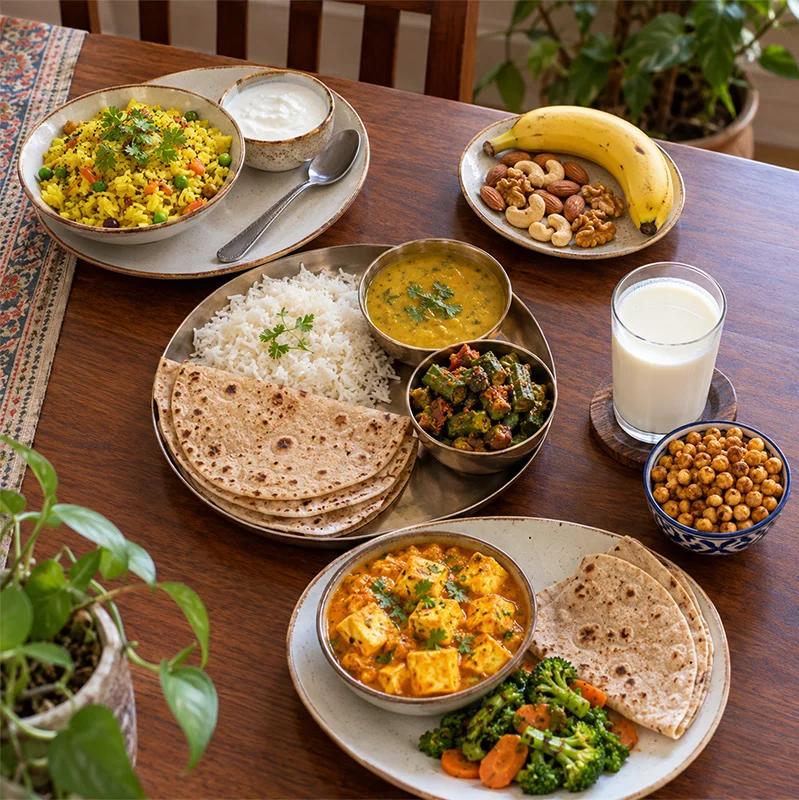
Where it comes from in this chart, every day: two katoris of dal (one at lunch, one at dinner), two glasses of milk, a katori of dahi, peanuts or chana as a snack, paneer or soya 3 to 4 times a week. Dal with rice or roti together make a better protein than either alone; that is why every Indian meal has both.
The Indian diet chart for weight gain: one day
Save this to your phone. Five rows, every day.
Time | Eat | Why it is here |
|---|---|---|
7:30 am Breakfast | 2 aloo or paneer parathas with ghee, a katori of dahi, 1 glass full-cream milk or poha with peanuts and potato, plus milk or 3 idlis with sambar and a spoon of ghee, plus milk | Wheat, potato, ghee, milk and dahi are all on Charaka's list. Dahi is fine in the morning. |
10:30 am Mid-morning | 1 banana and a handful of peanuts or 4 to 5 dates and a glass of milk or a sattu drink with jaggery | This is the meal thin people skip. It is 300 calories you were not eating. |
1:00 pm Lunch | A full katori of rice with 1 spoon ghee, a katori of dal (urad, moong, chana or arhar), a sabzi cooked in oil, 2 rotis, a katori of dahi or a glass of chaas | Rice, dal, ghee, dahi: the heart of Charaka's nourishing diet. Eat sitting down, then rest a few minutes. |
5:00 pm Evening | Paneer bhurji with 2 slices of bread or 2 potato-stuffed sandwiches or roasted chana with a glass of milk or a bowl of sweet potato | Replaces the chai-and-biscuit habit with food. Chai can come with it, not instead of it. |
8:00 pm Dinner | Rice with urad or moong dal and 1 spoon ghee or moong khichdi with a lot of ghee and a sabzi or 3 rotis with paneer or soya sabzi and dal | Charaka pairs rice with urad (masha) for the thin. No dahi at night: the old rule. |
10:00 pm Before bed | 1 glass warm full-cream milk | Milk is the first item on Charaka's list for the thin body. Then sleep, which is the second. |
Household measures. One katori is a standard small steel bowl, about 150 ml. One glass is about 250 ml. One spoon of ghee is a tablespoon, not a teaspoon. If in doubt, make the ghee a little more, not less.
7 days of lunches and dinners
Breakfast, snacks and bedtime milk stay the same every day; pick from the options above. Lunch and dinner rotate so you do not get bored:
Day | Lunch | Dinner |
|---|---|---|
Mon | Rice, arhar dal with ghee, aloo-gobi, roti, dahi | Rice, urad dal with ghee, lauki sabzi |
Tue | Rajma-chawal with ghee, salad, chaas | Moong khichdi with ghee, aloo-tamatar |
Wed | Rice, chana dal, bhindi, roti, dahi | 3 rotis, paneer sabzi, moong dal |
Thu | Chole-chawal with ghee, chaas | Rice, moong dal with ghee, baingan bharta |
Fri | Rice, sambar, potato fry in oil, dahi | Dal-dhokli or dal with roti, soya sabzi |
Sat | Rice, moong dal with ghee, aloo-matar, roti, dahi | Rice, urad dal with ghee, methi sabzi |
Sun | Paneer paratha with ghee, dahi, a glass of milk | Vegetable pulao with ghee, dal fry |
Weigh yourself once a week, same day, morning, before food. Half a kilo to one kilo a month is a good pace. If nothing moves in a month while you are truly eating five times, read our guide to why am I not gaining weight and get the tests it lists.
Ayurvedic diet for weight gain: Charaka's list
Charaka, Sutra Sthana 21. For the too-thin person: "light and nourishing therapy". The foods named: milk, ghee, dahi, shali rice, masha (urad), wheat, sugarcane, jaggery preparations, newly harvested grains. Not just food: sleep, a comfortable bed, contentment, a relaxed mind, freedom from anxiety, oil massage, pleasant surroundings.
Look at the chart above again. Rice and urad at dinner, ghee on everything, milk twice, dahi at lunch, wheat at breakfast, jaggery in the sattu. The chart is Charaka's list, cooked.
The rules that still apply (Sutra Sthana 7 and 26): dahi in the daytime, never at night, never heated, taken with something. Milk never with sour things, so no sour fruit in a milkshake. Honey never heated, so no honey in hot milk. Banana and chaas are a bad pair, so banana with milk at 10:30, chaas at 1:00, not together.
And the nap. Charaka forbids day sleep to the heavy person and allows it to the thin one. A short rest after lunch is part of the treatment.
What not to do
Chai and 2 biscuits at 5 pm → Paneer sandwich, then chaiProtein powder in water → Dal, milk, paneer, peanuts, chanaCake, cold drinks, chocolate "for calories" → Dates, banana, sattu, potatoWater or chai just before meals → Drink after the meal, not beforeOne huge dinner → Five medium mealsMorning run on an empty stomach → 20 minutes of squats and push-ups, then breakfast
The UK advice adds one more: "do not fill up on drinks before eating meals". Thin people often drink a glass of water or chai right before food and then cannot finish the plate.
An Indian diet chart for weight gain only works if you eat all five rows.
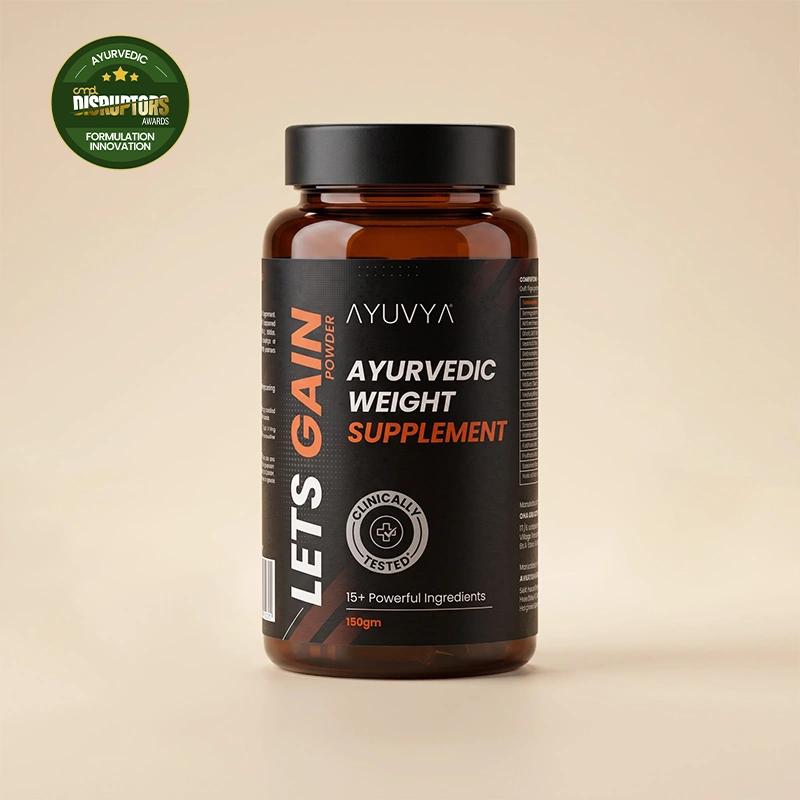
If appetite is the problem, that is where Ayuvya's i-Gain comes in: Ayurvedic herbs for appetite and nourishment, with this diet chart in the box. See i-Gain. Start the chart today either way.
This article is for general information. It is not medical advice. This chart is for adults who are underweight and otherwise healthy. If you have diabetes, high cholesterol, kidney disease or are losing weight without trying, see a doctor before following it. Calorie and protein figures are ICMR-NIN 2020 values for reference adults; your own need may differ.
Sources
- ICMR-NIN. Nutrient Requirements for Indians, 2020: brief note (energy 2,110/2,710/3,470 kcal for men, 1,660/2,130/2,720 for women; protein RDA 0.83 g/kg, 54 g and 45.7 g). nin.res.in
- NHS (UK). Advice for underweight adults (300 to 500 extra calories a day; smaller meals more often; not chocolate, cakes and sugary drinks; do not fill up on drinks before meals; strength training). nhs.uk
- ICMR-NIN Dietary Guidelines for Indians 2024, as reported by South First (no protein supplements for most people; sugar under 5% of energy). thesouthfirst.com
- World Health Organization, 2015 sugars guideline (free sugars under 10% of energy). who.int
- Charaka Samhita, Sutra Sthana 21 (nourishing therapy for the thin, verses 20 and 29–34; day sleep rules 39–50), Sutra Sthana 7 (dahi) and 26 (milk with sour foods, honey). carakasamhitaonline.com
- Bhojanakutuhala (banana with takra as an incompatible pair).