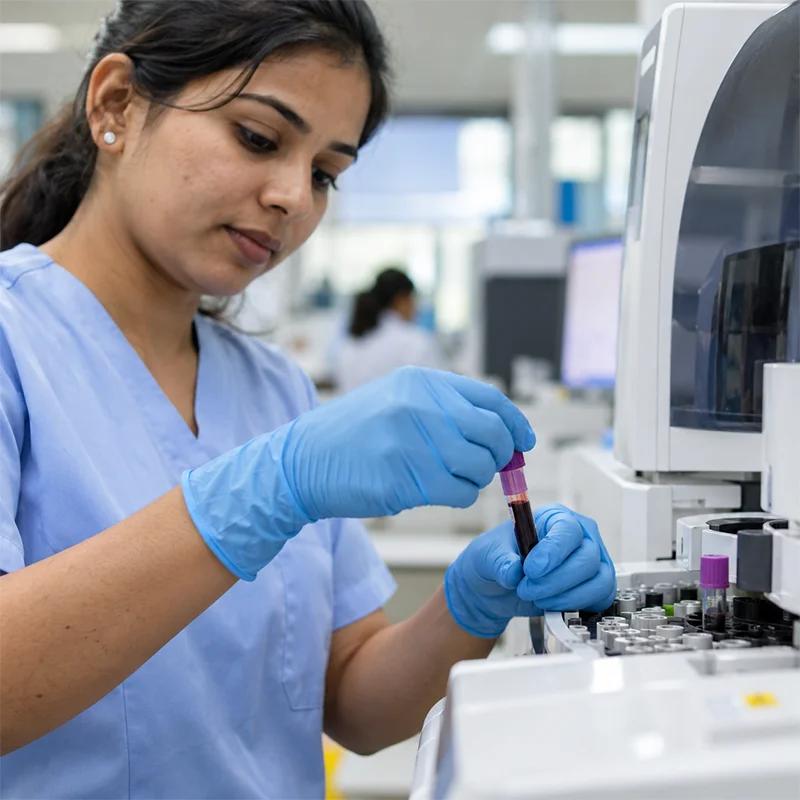
This guide uses India's official Standard Treatment Workflow for type 2 diabetes (Ministry of Health and Family Welfare, 2022) and the American Diabetes Association (ADA). They agree on every cut-off below. That matters: the ICMR-INDIAB survey found that 15.3% of Indians have prediabetes. These numbers are how you catch it.
Number 1: HbA1c normal range, your 3-month average
What it is: HbA1c (also written A1C) shows your average blood sugar over the past two to three months (ADA).
- Normal: below 5.7%
- Prediabetes: 5.7% to 6.4%
- Diabetes: 6.5% or higher
Source: ADA. India's Standard Treatment Workflow lists the same cut-offs.
Number 2: Fasting blood sugar normal range
What it is: your blood sugar after at least 8 hours with no food or drink except water (ADA).
- Normal: below 100 mg/dL
- Prediabetes: 100 to 125 mg/dL
- Diabetes: 126 mg/dL or higher
Getting the fast right: eat dinner at your usual time. Have nothing but water after it. Give the sample in the morning.
Number 3: Post meal blood sugar normal range
"After-meal" sugar shows up on reports in two different ways. They are not the same test:
For diagnosis: the OGTT. In this test you drink a standard sugar drink. Your sugar is measured 2 hours later:
- Normal: below 140 mg/dL
- Prediabetes: 140 to 199 mg/dL
- Diabetes: 200 mg/dL or higher
If you already have diabetes: the post-meal target. Aim for below 180 mg/dL, measured 1 to 2 hours after starting your meal (ADA; India's Standard Treatment Workflow).
To bring post-meal numbers down, the simplest habit is a 10-minute walk after eating. In one trial it cut post-meal sugar by 22% after dinner. Read: walking after meals for blood sugar.
Infographic: green-amber-red bars for HbA1c, fasting sugar and 2-hour sugar
HbA1c normal range, fasting and 2-hour sugar: one table
Test | Normal | Prediabetes range | Diabetes |
|---|---|---|---|
HbA1c | Below 5.7% | 5.7% to 6.4% | 6.5% or higher |
Fasting sugar (8+ hours) | Below 100 mg/dL | 100 to 125 mg/dL | 126 mg/dL or higher |
2-hour OGTT | Below 140 mg/dL | 140 to 199 mg/dL | 200 mg/dL or higher |
Random sugar | – | – | 200 mg/dL or higher, with symptoms |
Sources: American Diabetes Association; Ministry of Health and Family Welfare, Standard Treatment Workflow for type 2 diabetes (2022).
One high number is not a diagnosis. The ADA says each test usually needs to be repeated on a second day to confirm diabetes, unless sugar is very high or the classic symptoms are present.
HbA1c target for diabetics: India's numbers
If you already have diabetes, the question changes from "normal or not?" to "on target or not?". India's Standard Treatment Workflow sets:
Measure | Target |
|---|---|
HbA1c | 7.0% or below |
Before meals | 80 to 130 mg/dL |
After meals | Below 180 mg/dL |
Not the same for everyone: both India's guide and the ADA say a less strict target (the ADA mentions below 8%) may suit older people, people with other serious illnesses, and people at risk of low sugar. Your doctor sets your number.
How to read sugar test report: who should get tested
- Adults who are overweight (BMI 23 or more, by India's guide) with any risk factor, such as being over 30, should be tested.
- All pregnant women should be tested with a fasting test in the first three months (India's guide).
- If you have prediabetes (any number in the amber column), ask your doctor how often to re-test.
Reading your report in 60 seconds
- Find HbA1c first: below 5.7, 5.7 to 6.4, or 6.5 and above?
- Check fasting: below 100, 100 to 125, or 126 and above?
- Check whether the after-meal value is an OGTT or a post-meal reading. Compare it with the right range.
- If you have diabetes, compare with your targets: HbA1c 7% or below, before meals 80 to 130, after meals below 180.
- Take it to your doctor. The numbers start the talk. Your doctor decides the treatment.
Image: person circling values on a sugar report, phone calendar reminder beside it
Printable card: HbA1c normal range, fasting and 2-hour sugar ranges, and targets
Working towards the HbA1c normal range? Add daily support.
Ayuvya Diabo is made for people who want healthy sugar levels. See Diabo. Take it along with your doctor's medicine, diet and daily walks, not instead of them.
Read next:
- Walking after meals for blood sugar: the 10-minute rule
- Foods that increase blood sugar: the list Charaka wrote
- Lipid profile normal range: check your cholesterol too
Frequently asked questions
What is the HbA1c normal range?
Below 5.7% is normal. 5.7% to 6.4% is prediabetes. 6.5% or higher means diabetes. This is from the American Diabetes Association and India's Health Ministry treatment guide. For people already diagnosed, India's target is HbA1c of 7% or below.
What is the fasting blood sugar normal range?
Below 100 mg/dL after at least 8 hours without food is normal. 100 to 125 mg/dL is prediabetes. 126 mg/dL or higher means diabetes. A diagnosis usually needs a repeat test on another day.
What should post meal blood sugar be?
For people with diabetes, India's Health Ministry and the American Diabetes Association set a post-meal target below 180 mg/dL, measured 1 to 2 hours after starting the meal. For diagnosis, doctors use a 2-hour glucose drink test (OGTT): below 140 mg/dL is normal, 140 to 199 is prediabetes, and 200 or more means diabetes.
How often should HbA1c be tested?
HbA1c shows your average blood sugar over the past two to three months. So there is no point repeating it every week. Your doctor will set the schedule based on your treatment.
This article is for general information. It is not medical advice. Lab ranges can differ a little. Use the range printed on your report and your doctor's advice. Do not start, stop or change any medicine based on this article.
Sources
- Ministry of Health and Family Welfare / ICMR: Standard Treatment Workflow, Diabetes Mellitus Type 2 (2022)
- American Diabetes Association: Diagnosis
- American Diabetes Association: Glycemic targets, Standards of Care in Diabetes (2023)
- Lessons learnt from the ICMR-INDIAB study (Anjana RM and colleagues, Lancet Diabetes Endocrinol, 2023). National Medical Journal of India
- University of Otago: Short walks after meals (Reynolds AN and colleagues, Diabetologia, 2016)