This guide covers what the trials found, the one form of flaxseed for cholesterol that did not work, the full Ayurvedic rule for alsi (including the parts most blogs skip), and two simple recipes.
Flaxseed for cholesterol: what 28 studies found
In 2009, researchers pooled 28 studies on flaxseed and blood fats (Pan et al., American Journal of Clinical Nutrition). Here is what they reported for whole flaxseed:
- Total cholesterol: down by about 0.21 mmol/L (about 8 mg/dL).
- LDL ("bad") cholesterol: down by about 0.16 mmol/L (about 6 mg/dL).
- HDL and triglycerides: no significant change.
- Who benefited most: the effect was clearer in women, especially after menopause, and in people who started with high cholesterol.
To be honest about the size: this is a modest drop. Alsi is a helpful daily habit alongside the other foods in this series, not a replacement for medicine your doctor has prescribed.
Ground vs whole flaxseed: why nani's grinding mattered
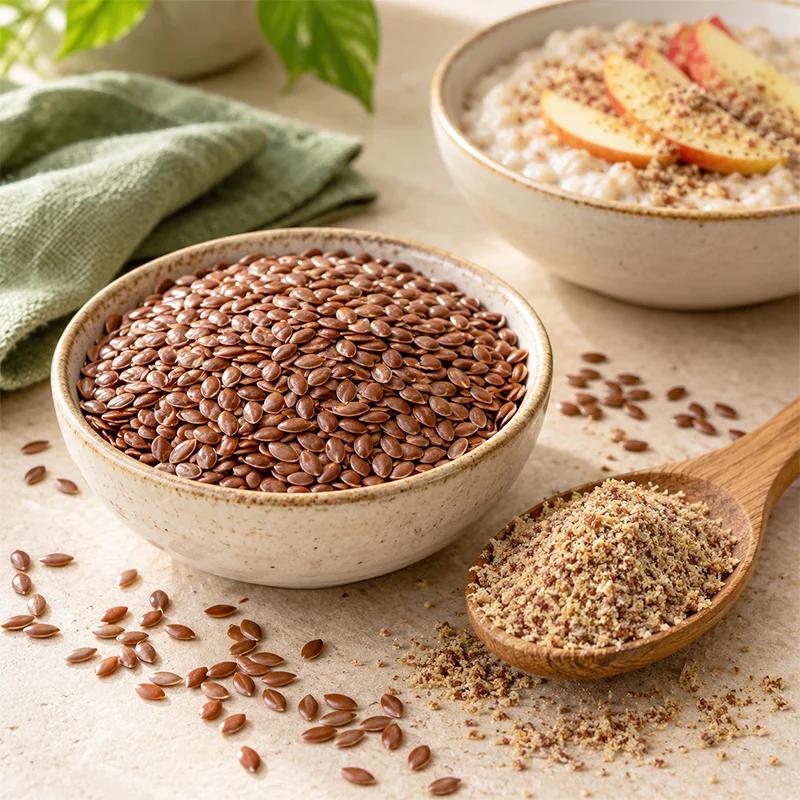
Whole seeds, swallowed → Roasted and ground
Mayo Clinic says most nutrition experts recommend ground flaxseed over whole, because ground flaxseed is easier to digest. Whole flaxseed may pass through your intestine undigested, so you miss most of the benefit.
So if you have been swallowing a spoon of whole alsi with water, grind it instead. Roast and grind a small batch at a time, and keep it in an airtight jar.
Flaxseed oil for cholesterol: the surprise
In the same 28-study analysis, flaxseed oil did not lower cholesterol. Whole flaxseed and flaxseed lignan supplements did. So the bottle of alsi oil is not a shortcut: for cholesterol, eat the seed.
Flaxseed in Ayurveda: the full rule, not half of it
Many articles quote only the good parts. Here is the complete description of alsi (uma, also called atasi) from Ashtanga Hridaya, Sutra Sthana 6:
snigdhomā svādutiktoṣṇā kaphapittakarī guruḥ |
dṛkśukrahṛt kaṭuḥ pāke ...
Alsi is:
- Snigdha (unctuous) and guru (heavy, hard to digest)
- Sweet and bitter in taste, pungent after digestion
- Ushna (hot in potency)
- It increases kapha and pitta
- It is not good for the eyes or for shukra (reproductive tissue)
What this means for someone with high cholesterol
Excess cholesterol sits close to excess kapha and meda in Ayurvedic thinking, and alsi is heavy and kapha-raising. So Ayurveda does not treat alsi as something to eat by the bowl. Charaka's rule for heavy foods is clear: heavy articles should be taken only up to one-third or one-half of your capacity (Charaka Sutra 5/7).
Where science and Ayurveda meet: a small, measured amount of ground alsi, eaten as part of a meal. Not a heaped bowl, and not every remedy at once.
Who should go easy on alsi
- People who run "hot" (acidity, burning, heat-related problems), because alsi is ushna and raises pitta.
- People with heavy digestion or excess kapha, because it is guru and raises kapha.
- Anyone on regular medicines: see the timing note in the next section.
How to eat flaxseed for cholesterol, step by step
- Grind it. Roast lightly, cool and grind. Whole seeds may pass undigested (Mayo Clinic).
- Keep the amount small. Mayo Clinic's serving idea is one tablespoon of ground flaxseed (about 7 g, 37 calories). That also respects Ayurveda's limit on heavy foods.
- Eat it with food. Mix it into atta, sprinkle it on dal-rice or have it as chutney with roti.
- Drink enough water. Like other fibre, flaxseed should be taken with plenty of water or other fluids (Mayo Clinic).
- Keep it away from your tablets. Mayo Clinic says flaxseed shouldn't be taken at the same time as oral medicines. Ask your doctor how to space them.
2 recipes from nani's kitchen
1. Javas chutney recipe (Maharashtrian alsi chutney)
A dry chutney eaten a teaspoon at a time, which suits Ayurveda's "small amount" rule perfectly.
Makes: about 12 servings of 1 teaspoon. Time: 10 minutes.
- 1/2 cup alsi (flaxseed)
- 6 garlic cloves
- 1 tsp red chilli powder
- Salt to taste
- Dry-roast the alsi in a kadhai on low heat, stirring, until the seeds start to crackle. Cool completely.
- Grind with garlic, red chilli and salt to a coarse powder, using short pulses.
- Store in an airtight jar. Eat about 1 teaspoon with roti, bhakri or dal-rice.
Bonus from the garlic: a meta-analysis found garlic lowered total cholesterol by about 17 mg/dL and LDL by about 9 mg/dL when taken for more than 2 months (Ried et al., 2013). In Ayurveda, garlic is warming and can increase pitta when eaten in large amounts, so pitta-prone people can use fewer cloves.
2. Alsi roti
The easiest daily habit: your normal roti, with a spoon of ground alsi in the atta.
- 1 cup whole-wheat atta
- 1 tbsp ground roasted alsi
- A pinch of salt, and water as needed
Mix, knead into a soft dough, rest for 10 minutes, and cook like a normal roti. For extra fibre, use jau (barley) atta for part of the wheat, as explained in our food swaps guide.
What about alsi pinni? Pinni is a much-loved winter sweet, but it is usually made with plenty of ghee and jaggery or sugar. Enjoy it as an occasional treat; for flaxseed for cholesterol every day, the chutney and roti are the better fit.
Alsi seeds benefits start with knowing the name
Ask for it by the name your local kirana store uses:
Language | Name |
|---|---|
Hindi | Alsi |
Bhojpuri / Bihar, Jharkhand | Tisi |
Marathi | Javas |
Bengali | Tishi |
Tamil | Ali vidhai |
Telugu | Avise ginjalu |
Kannada | Agase |
Sanskrit | Atasi, Uma |
Flaxseed for cholesterol at a glance
Question | Answer | Source |
|---|---|---|
Does it lower cholesterol? | Yes, modestly: total −8 mg/dL, LDL −6 mg/dL on average | Pan 2009, 28 studies |
Whole, ground or oil? | Ground seed. Oil did not lower cholesterol | Pan 2009; Mayo Clinic |
How much? | About 1 tablespoon of ground alsi with a meal | Mayo Clinic; Charaka Sutra 5/7 |
Ayurvedic nature | Heavy, unctuous, hot; increases kapha and pitta | Ashtanga Hridaya Sutra 6 |
Precautions | Plenty of water; not at the same time as tablets | Mayo Clinic |
Adding flaxseed for cholesterol to your meals? Add daily support too. Ayuvya Cholest Pro Juice is made for people working on healthy cholesterol levels. Make it part of the same daily routine.
Read next:
- 6 foods that lower cholesterol naturally
- Food swaps to lower cholesterol: 5 easy kitchen changes
- Indian breakfast for cholesterol: 3 recipes under 20 minutes
This article is for general education and is not medical advice. Flaxseed supports healthy cholesterol as part of a balanced diet; it does not diagnose, treat or cure any disease. If you take medicines, have a digestive or other medical condition, or are pregnant or breastfeeding, ask your doctor before adding flaxseed.
Sources
- Pan A et al. Meta-analysis of the effects of flaxseed interventions on blood lipids. Am J Clin Nutr, 2009
- Mayo Clinic: Does ground flaxseed have more health benefits than whole flaxseed?
- Ashtanga Hridaya, Sutra Sthana 6 (Annaswarupa Vijnaniya Adhyaya): seeds of uma (linseed)
- Charaka Samhita, Sutra Sthana 5 (Matrashitiya Adhyaya), verse 7
- Ried K et al. Effect of garlic on serum lipids: an updated meta-analysis. Nutr Rev, 2013
- Dr. D. Y. Patil College of Ayurved: Ayurvedic health benefits of garlic